The Ice Cream Man’s Secret
Introduction: A Man With a Broken Heart
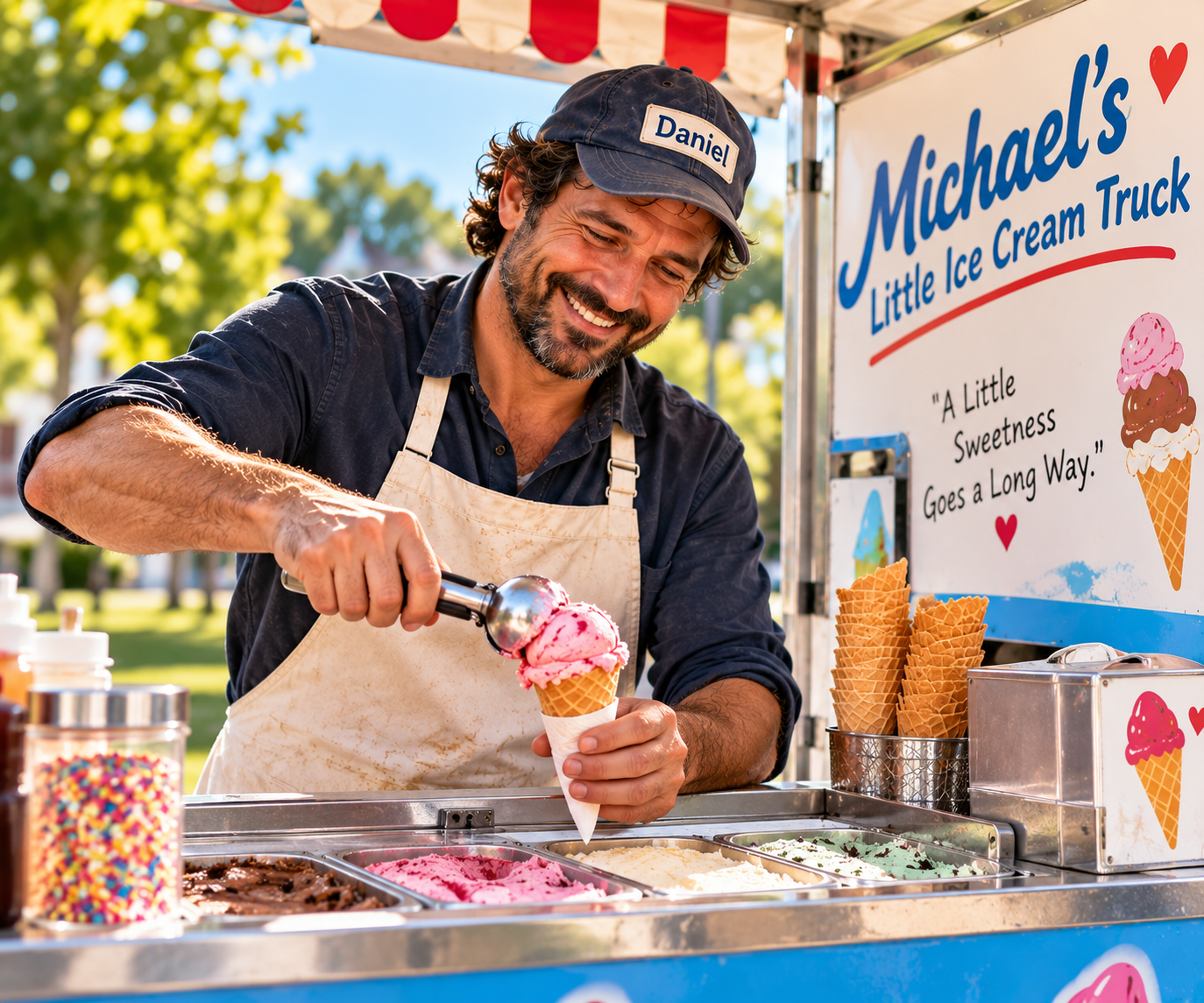
Every afternoon, when the school bells rang and children rushed out through the gates, an old ice cream truck appeared at the end of the street. Its cheerful music echoed through the neighborhood, and children ran toward it with smiles on their faces.
Behind the counter stood a middle-aged man with tired eyes, a gentle smile, and a heart that carried a pain few people could understand.
His name was Daniel.
To the children, Daniel was the kindest ice cream man in town. He sold ice cream for just a few cents, sometimes gave it away for free, and always had time to listen to their stories. He remembered their names, celebrated their small victories, and comforted them when they were sad.
But there was a reason Daniel loved children so deeply.
Years earlier, he had lost the one child he would have given anything to save—his own son.
And every time a child smiled at him, Daniel felt as though a small piece of his lost world had returned.
This is the story of a troubled father who lost everything that mattered, confronted the mistakes of his past, and discovered that even a broken heart could learn to love again.
Chapter 1: The Father He Never Meant to Become
Daniel had not always been the gentle man everyone knew.
When he was younger, he worked hard and dreamed of giving his family a comfortable life. He married his childhood sweetheart, Sarah, and together they welcomed a little boy named Michael.
Michael was a cheerful child with bright eyes and an endless curiosity about the world.
He loved toy cars, bedtime stories, chocolate milk, and the sound of his father’s footsteps coming through the front door.
Whenever Daniel returned home from work, Michael would run toward him with his arms stretched wide.
“Daddy! Daddy! You’re home!”
But Daniel’s life gradually began to fall apart.
Financial problems, disappointment, and personal struggles pushed him toward alcohol. What began as an occasional drink slowly became a dangerous habit. Eventually, alcohol controlled much of his life.
He started missing family dinners. He forgot promises he had made to Michael. Some evenings, he came home too intoxicated to play with his son.
Michael never stopped waiting for him.
One Saturday morning, the little boy stood beside Daniel’s bed, holding a picture he had drawn.
“Daddy, look! I drew us together.”
Daniel barely opened his eyes.
“Not now, Michael. Go play.”
The boy lowered his drawing and quietly walked away.
It was a small moment, easily forgotten by someone who did not understand its importance.
But years later, Daniel would remember it with heartbreaking clarity.
He would remember the disappointment in his son’s eyes.
He would remember every hug he had refused, every story he had ignored, and every moment he had allowed alcohol to steal from his family.
At the time, however, he believed he had plenty of time to make things right.
He was wrong.
Chapter 2: The Day His World Fell Silent
Michael became seriously ill.
At first, Daniel struggled to understand how quickly his son’s condition was worsening. What began as a frightening illness soon became a battle that changed the entire family’s life.
Sarah stayed beside their son, praying for his recovery. Doctors worked tirelessly to help him.
Daniel sat in the hospital, staring at the small bed where his little boy lay.
For the first time in years, he was completely sober and fully present.
He held Michael’s hand.
“Buddy, please get better,” he whispered. “I’ll take you anywhere you want. We’ll play together every day. I’ll be the father you deserve. I promise.”
Michael looked at him weakly.
“Daddy, will you stay with me?”
Daniel’s eyes filled with tears.
“Of course, son. I’m right here.”
He wished he could trade places with his child. He wished he could erase every mistake he had made. He wished he could return to the mornings when Michael had waited for him with a drawing in his hand.
But wishes could not change what was happening.
Despite the doctors’ efforts, Michael died.
He was still a little boy with a lifetime of dreams ahead of him.
Daniel’s world collapsed.
At the funeral, he stood beside his son’s small coffin, unable to accept that the child who had once run toward him with open arms would never do so again.
When everyone had gone, Daniel remained alone.
He remembered Michael’s voice.
He remembered the unanswered questions.
Most painfully, he remembered the promise he had made in the hospital.
He had promised to become a better father, but he had made that promise when his son was already slipping away.
“I thought I had more time,” he whispered.
Those five words became the heaviest burden of his life.
Chapter 3: The Man Who Had Nothing Left to Hide From
After Michael’s death, Daniel’s marriage began to crumble under the weight of grief.
Sarah was heartbroken, too. She had lost her child and watched her husband struggle with addiction for years.
Eventually, their relationship ended.
Daniel found himself living alone in a small apartment. The silence inside it was unbearable.
There were no little footsteps running down the hallway. No toys scattered across the floor. No child waiting at the window.
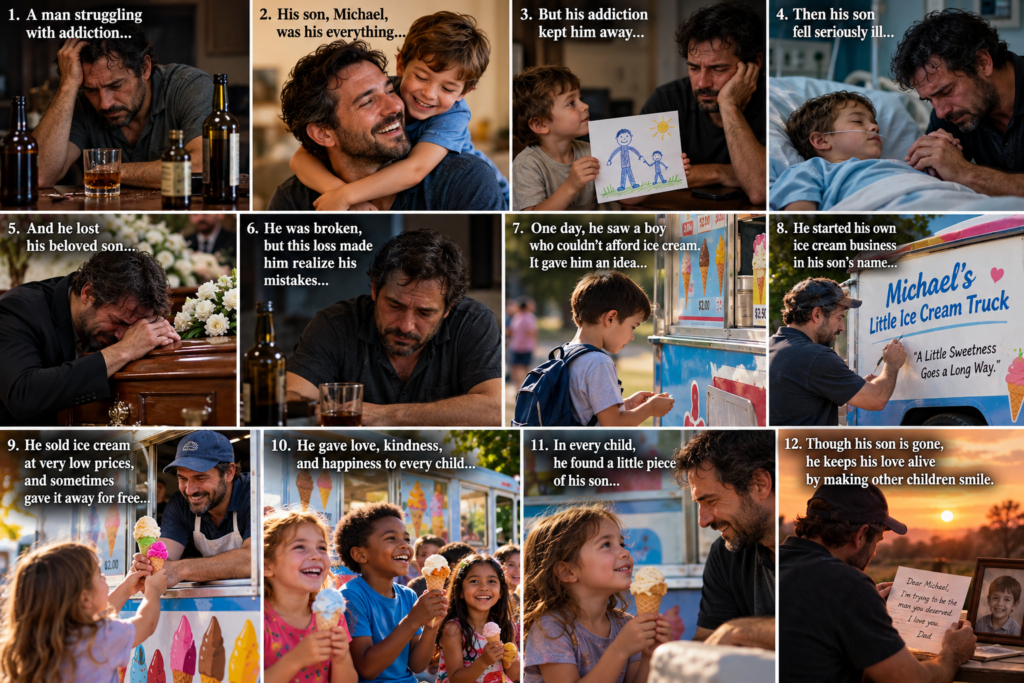
For a while, Daniel tried to escape his pain the same way he always had—through alcohol.
But drinking no longer offered the relief he wanted.
Instead, every night brought the same memories.
He saw Michael standing beside his bed with a drawing.
He heard his son asking him to stay.
He remembered the final promise.
One cold morning, Daniel looked at himself in the bathroom mirror.
His face was tired. His eyes were bloodshot. His hands trembled.
He barely recognized the man staring back at him.
For the first time, he stopped blaming the world for his suffering.
He admitted that he had made terrible choices.
He could not blame himself for his son’s illness or death, but he could acknowledge that his addiction had kept him from being the father Michael needed.
That realization did not heal him overnight.
It did, however, give him a reason to change.
Daniel sought help for his drinking and began rebuilding his life one difficult day at a time.
He knew he could never undo the past.
But perhaps he could make the future mean something.
Chapter 4: A Simple Idea That Changed Everything
One afternoon, Daniel walked past an elementary school.
Children were spilling through the gates, laughing and talking about their day.
Near the sidewalk, a young boy stood apart from the others. He was looking at an ice cream truck, counting a few coins in his palm.
The boy approached the vendor.
“How much is a chocolate ice cream?”
The vendor named the price.
The boy counted his coins again. He did not have enough.
“Oh,” he said quietly. “Never mind.”
He turned away, trying to hide his disappointment.
Daniel watched him walk back toward his friends.
Something inside him stirred.
He remembered Michael’s excitement whenever he received a small treat. He remembered how his son used to press his face against the window of an ice cream shop.
Daniel wondered how many children missed out on little moments of happiness simply because their families could not afford them.
That evening, an idea began to take shape.
He would sell ice cream.
Not to become rich.
Not to build a business empire.
He wanted to create a place where children could experience a little happiness without worrying about how much money they had.
The following months were difficult. Daniel had very little money, but he saved what he could, bought a used ice cream cart, and learned how to manage a small business.
He chose a simple name for it:
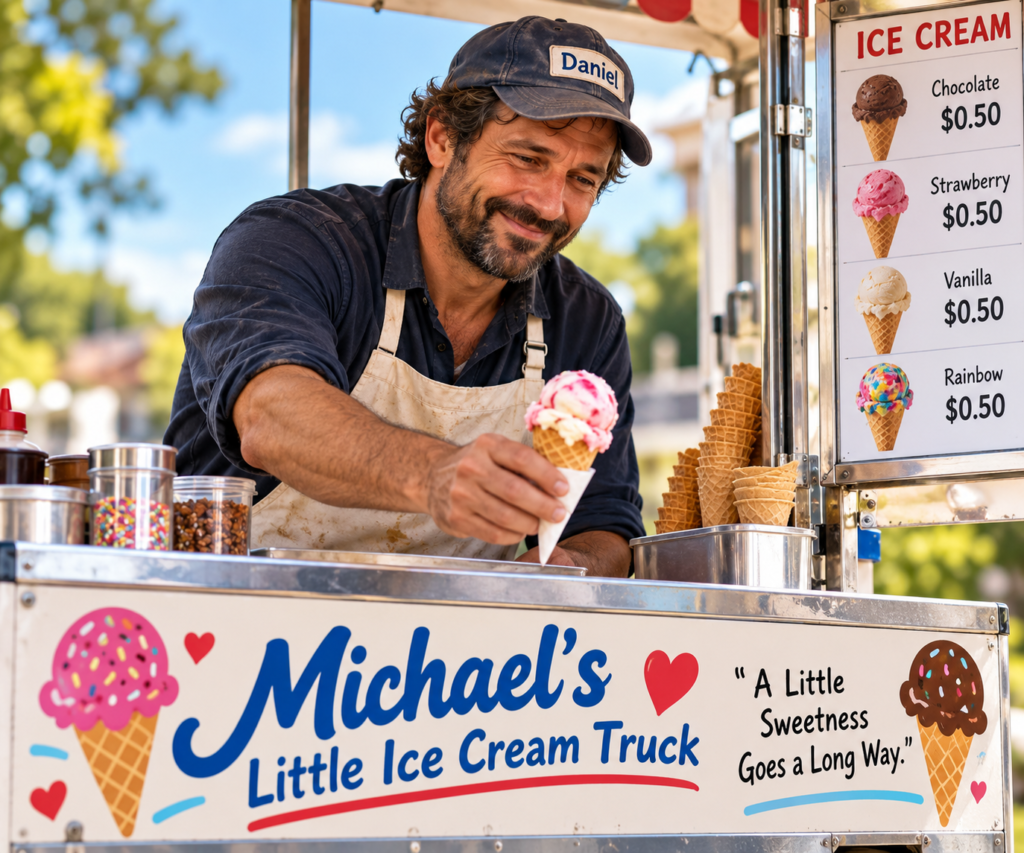
Michael’s Little Ice Cream Truck.
He painted the name on the side in bright blue letters.
Beneath it, he added a small message:
“A Little Sweetness Goes a Long Way.”
When Daniel saw the finished cart, tears filled his eyes.
For the first time since his son’s death, his tears carried something other than despair.
They carried hope.
Chapter 5: The Ice Cream Man Who Charged Almost Nothing
Daniel began selling ice cream near schools, parks, and playgrounds.
His prices were much lower than those of other vendors.
A small ice cream cone cost only a few cents. When children came up short, he often covered the difference himself.
Sometimes, he gave ice cream away for free.
“If you don’t have enough money today, that’s okay,” he would tell them. “You can still have a little happiness.”
At first, some parents wondered how he managed to keep his business running.
Daniel simply smiled.
“I make enough to get by,” he explained. “That’s all I need.”
Soon, children began recognizing his truck.
They waved when they saw him coming. They saved their coins to buy their favorite flavors. They told him about school, their pets, their siblings, and their dreams.
Daniel listened to every story as if it mattered.
Because to him, it did.
He learned that Tommy wanted to become a firefighter. Emily dreamed of being a doctor. Little Jacob loved dinosaurs and could name dozens of different species.
Daniel remembered their favorite flavors, too.
“Chocolate for Tommy!”
“Strawberry for Emily!”
“And something extra cold for the dinosaur expert!”
The children laughed.
For those few minutes, the world seemed brighter.
Daniel never told them they were helping him heal. They were children, and he did not want them to carry the weight of his sadness.
He simply wanted them to feel loved.
Whenever he watched them run back to their friends, he imagined Michael among them.
He knew these children were not replacements for his son.
No child could ever replace Michael.
But caring for them gave him a way to express the love he had carried for so long.
Chapter 6: The Little Girl With Empty Pockets
One summer afternoon, a little girl named Lily approached Daniel’s truck.
She wore an old yellow dress and held a few coins in her hand.
“Sir, how much is the vanilla ice cream?”
Daniel told her the price.
She counted her money.
Then she looked up at him.
“I’m sorry. I don’t have enough.”
Daniel smiled.
“That’s all right, sweetheart. Vanilla is your lucky flavor today.”
He handed her a generous scoop.
Lily looked surprised.
“But I can’t pay for it.”
“Sometimes,” Daniel replied gently, “people do nice things simply because they can.”
The little girl accepted the ice cream with both hands.
“Thank you!”
She took a bite, and her face lit up.
Then she looked at Daniel and asked a question that stopped him cold.
“Do you have a little boy, too?”
Daniel’s smile faded slightly.
“I did,” he answered softly. “His name was Michael.”
“Where is he now?”
Daniel took a slow breath.
“He isn’t here anymore, sweetheart.”
Lily looked down at her ice cream.
“I’m sorry.”
For a moment, neither of them spoke.
Then she reached across the counter and gently patted his hand.
“It’s okay,” she said. “You can still tell him you love him.”
Daniel could not hold back his tears.
He turned his face away, but Lily noticed.
She gave him a small, reassuring smile before running back to her mother.
That evening, Daniel sat beside his cart long after the last customer had left.
For years, he had believed that the love he failed to give Michael had become a permanent debt he could never repay.
Now he understood something important.
Love was not a debt that could be paid off.
It was something that could be carried forward.
Chapter 7: The Day the Neighborhood Learned His Story
As the years passed, Daniel became a familiar and beloved figure in the neighborhood.
Parents trusted him. Teachers greeted him warmly. Children ran to his truck after school.
One day, a local teacher named Mrs. Anderson approached him.
“Daniel, may I ask you something?”
“Of course.”
“Why do you charge so little? You could earn much more if you raised your prices.”
Daniel looked at the children gathered around his cart.
“Because I know what it’s like to lose something you can never get back,” he answered. “I lost my son. I can’t give him the childhood he deserved. But I can make a few other children happy.”
Mrs. Anderson listened quietly.
“What’s your son’s name?”
“Michael.”
Daniel told her about his addiction, his regrets, and the promise he had made in the hospital.
He did not try to excuse his mistakes.
“I can’t change what happened,” he said. “I only wish I had understood sooner that being a father means showing up. It means putting down what is hurting you and picking up the hand of the child who needs you.”
Mrs. Anderson was deeply moved.
She later shared his story with other teachers and families in the community—with Daniel’s permission.
Soon, people began supporting his little business.
Some bought extra ice cream to help cover the cost of free treats. Others donated supplies or helped repair his old truck.
Daniel never asked anyone to do these things.
He simply continued showing up, one afternoon at a time.
His small ice cream cart had become something bigger than a business.
It had become a symbol of kindness.
Chapter 8: A Letter to Michael
Many years later, Daniel sat at his kitchen table and wrote a letter to his son.
He knew Michael would never read it, but he needed to say the words he had kept inside for so long.
“Dear Michael,
I’m sorry I wasn’t the father you needed me to be.
I’m sorry for the times you waited for me and I didn’t come. I’m sorry for the stories I never listened to, the games I never played, and the hugs I should have given you.
I used to think I had all the time in the world.
I was wrong.
I cannot bring you back, and I cannot change the past. I wish more than anything that I could sit beside you, hear your laugh, and watch you grow up.
Every day, I meet children who remind me of you.
I remember your smile when they laugh. I remember your excitement when they choose their favorite ice cream. Sometimes, I imagine what you might have become.
I hope you would be proud of me.
I’m trying, son. I’m trying to be the man you deserved.
I love you, Michael.
I always did. I just wish I had shown you better.
Love,
Dad.”
Daniel folded the letter and placed it inside a small wooden box containing Michael’s childhood drawings.
Then he closed the lid.
Outside, he could hear children playing in the distance.
The next afternoon, he would open his ice cream cart again.
He would greet the children by name.
He would sell them their favorite flavors.
And if a child arrived without enough money, he would find a way to make that little moment of happiness possible.
Not because he believed he could erase his mistakes.
But because he finally understood what it meant to love.
Conclusion: The Sweetness That Remains
Daniel never became wealthy.
His old ice cream truck never turned into a major business, and his story never made national headlines.
But in his neighborhood, he became someone people would remember for generations.
Children grew up and moved away. Some returned years later with children of their own, introducing them to the kind man who had once sold them ice cream for a few cents.
They remembered his gentle smile.
They remembered the free treats.
Most of all, they remembered how he made them feel.
Daniel had once been a man who allowed addiction to distance him from the people he loved most. After losing his son, he could have spent the rest of his life trapped in regret.
Instead, he chose to change.
He could not give Michael another childhood, but he could offer kindness to the children who crossed his path.
He could not hear his son’s laughter again, but he could bring smiles to other children’s faces.
And although no act of kindness could undo his loss, every small gesture gave his remaining years a new purpose.
Perhaps that was his greatest lesson.
You cannot change the love you failed to give yesterday, but you can choose how much love you give today.
Sometimes, the people who have experienced the deepest pain become the most determined to prevent others from feeling alone.
And sometimes, an ordinary ice cream truck becomes something extraordinary—not because of the treats it sells, but because of the love it carries.
For Daniel, every scoop was a reminder of the son he had lost.
Every smile was a small act of redemption.
And every child who walked away with an ice cream cone carried a little piece of a father’s love into the world.
Because even when life takes away the people we love, it cannot take away our ability to choose kindness.
And sometimes, the sweetest thing we can leave behind is not a fortune, a business, or a name.
It is the memory of how we made other people feel.

Post Comment