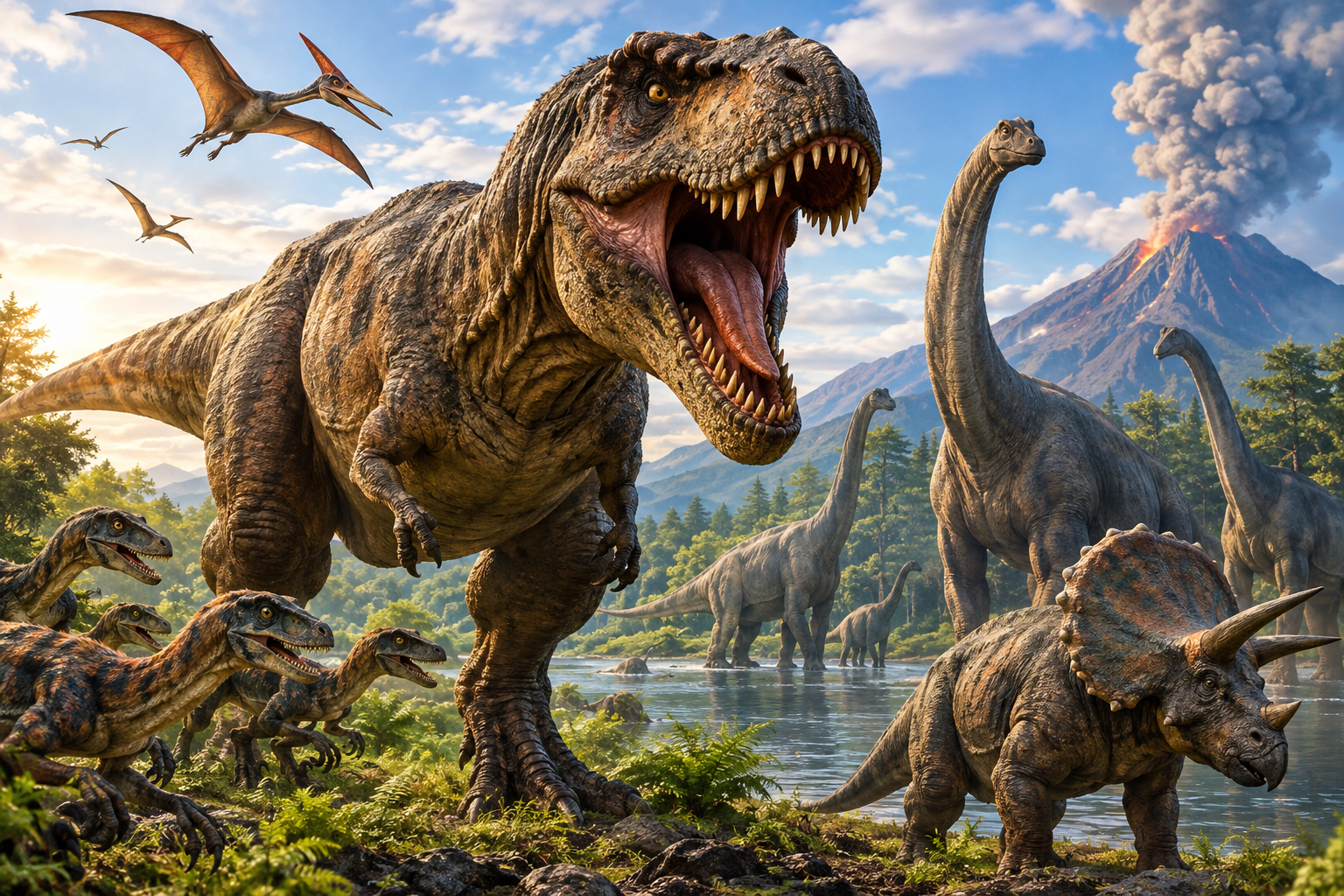
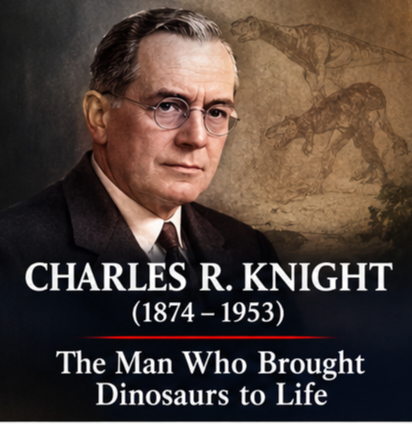
Charles R. Knight: The Man Who Brought Dinosaurs to Life
Long before modern computer graphics, blockbuster dinosaur movies, and realistic digital reconstructions, people had to imagine what dinosaurs looked like when they were alive.
One American artist played an extraordinary role in shaping that imagination.
His name was Charles R. Knight.
Born in Brooklyn, New York, on October 21, 1874, Knight became one of the most influential wildlife artists and paleoartists of the twentieth century. Although he was not a paleontologist, his paintings transformed fossil skeletons into powerful images of living animals. His dinosaurs were no longer lifeless bones buried in the ground. They became predators, herbivores, fighters, parents, and inhabitants of ancient landscapes.
Knight worked closely with scientists and museums, particularly the American Museum of Natural History. His paintings and murals helped generations of Americans visualize a prehistoric world that nobody had ever seen.
Today, many of his scientific interpretations have been revised or replaced as paleontology has advanced. Yet his importance has not disappeared. Knight helped create the visual language through which the public came to understand dinosaurs.
A Boy Fascinated by Animals
Charles Robert Knight was born in Brooklyn in 1874.
From an early age, he showed an extraordinary interest in animals and nature. Rather than simply looking at animals, Knight wanted to understand their bodies, movements, expressions, and behavior.
That interest would become the foundation of his career.
Knight’s artistic education was unusual because much of his knowledge came from observing real animals. He studied living creatures in museums, zoos, and other settings and used those observations when reconstructing extinct animals.
This was extremely important.
During the late nineteenth century, paleontology was developing rapidly. Scientists were discovering dinosaur fossils in the American West, but fossils alone could not show the public exactly how those animals had looked in life.
A skeleton could reveal bones.
It could not easily reveal skin, muscles, posture, movement, bhavior, or the environment in which an animal lived.
That was where Knight’s artistic imagination became valuable.
The Beginning of His Career
Knight began working professionally as an artist while still young.
The American Museum of Natural History eventually became one of the most important institutions in his career. In the 1890s, he began working with scientists who wanted extinct animals reconstructed for museum displays.
In 1894, Knight was commissioned to create a restoration of an extinct mammal known at the time as Elotherium, now generally associated with the genus Entelodon.
Rather than simply drawing a skeleton, Knight studied living animals that could help him understand the extinct creature’s anatomy.
He looked at modern mammals and tried to determine how muscles and tissues might have covered the fossil bones.
This approach became one of the defining features of his career.
Knight did not see fossils merely as collections of bones.
He saw them as the framework of once-living animals.
Working With Paleontologists
Knight’s success brought him into contact with some of America’s leading paleontologists.
Among the most important figures in his career was Henry Fairfield Osborn, a prominent paleontologist associated with the American Museum of Natural History.
Knight and Osborn developed a long professional relationship. The museum commissioned Knight to produce restorations that could be displayed alongside fossils.
The partnership between scientist and artist was important because paleontology was still a young field.
Scientists could examine bones and reconstruct skeletons, while Knight could use anatomy, observation, and artistic judgment to turn those scientific interpretations into images of living animals.
The resulting paintings became an important part of museum education.
Visitors who saw a dinosaur skeleton could now look at Knight’s painting and imagine that animal moving through a prehistoric landscape.
The American Museum of Natural History records that Knight’s association with the museum began in the 1890s and continued for more than five decades.
Leaping Laelaps
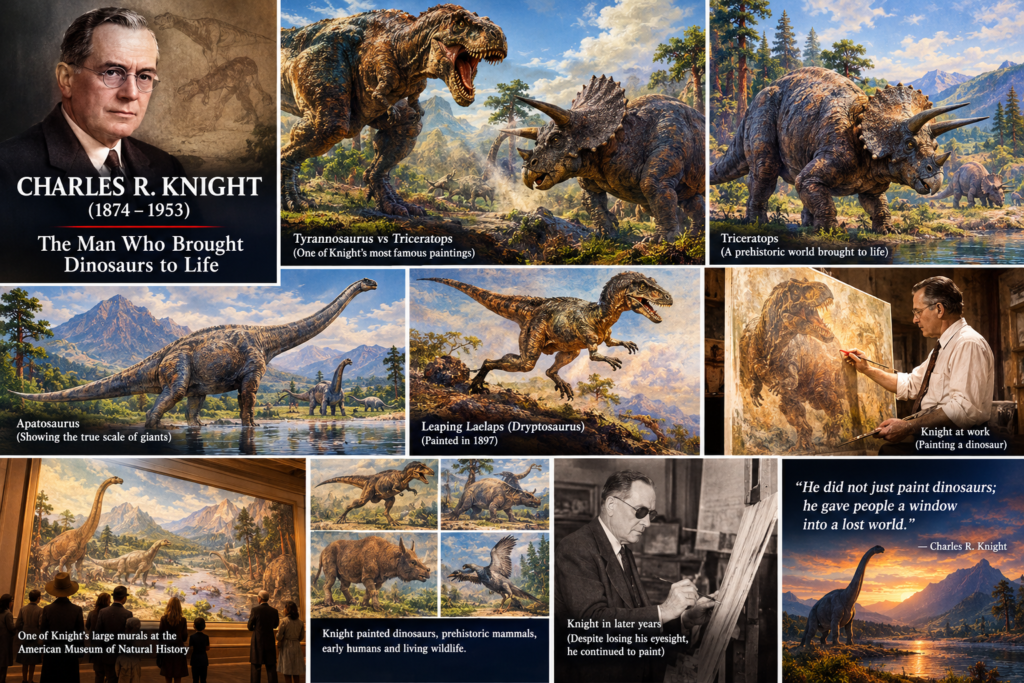
One of Knight’s most famous early dinosaur paintings was Leaping Laelaps, created in 1897.
The painting depicted Dryptosaurus, a predatory dinosaur, in an energetic confrontation.
At the time, dinosaurs were often imagined as slow, heavy, reptile-like creatures.
Knight presented something different.
His dinosaur appeared active and dangerous.
It was not simply standing beside a rock.
It was moving.
That helped change the way the public imagined dinosaurs.
Knight’s work showed that prehistoric animals could be presented as dynamic creatures engaged in movement and conflict.
The painting became an important example of his approach and helped establish his reputation as a pioneering dinosaur artist. PBS notes that Knight was among the first artists to portray dinosaurs as fast-moving and aggressive animals.
Bringing Bones to Life
Knight’s greatest talent was not simply drawing dinosaurs.
It was making them appear alive.
To accomplish this, he studied living animals.
He examined their anatomy, watched how they moved, and considered how muscles might operate beneath the skin.
He also paid attention to animal behavior.
A dinosaur was therefore not just a collection of anatomical features in Knight’s paintings. It became part of a larger ecosystem.
A predator might stalk prey.
A herbivore might defend itself.
A group of animals might move across a landscape.
This approach made his paintings dramatically different from simple scientific diagrams.
His images had atmosphere and emotion.
They showed prehistoric life as a world rather than a collection of fossils.
The Tyrannosaurus Becomes a Monster
Few dinosaurs became more closely associated with Knight’s imagination than Tyrannosaurus.
Knight’s Tyrannosaurus paintings helped establish an enduring popular image of the giant predator.
Large jaws.
Powerful legs.
A massive body.
An intimidating presence.
One famous tradition in dinosaur art presented Tyrannosaurus and Triceratops as mortal enemies.
Modern paleontology has revealed that many aspects of these classic scenes were speculative, and scientists continue to revise our understanding of dinosaur behavior and appearance.
But the images had enormous cultural influence.
They became part of the public imagination long before dinosaurs became global movie stars.
Triceratops and the Prehistoric World
Knight also became famous for his representations of Triceratops.
The three-horned dinosaur was one of the creatures that benefited enormously from his artistic treatment.
Instead of presenting Triceratops as an isolated skeleton, Knight placed it in an environment.
Plants, water, rocks, trees, and other animals helped create a believable prehistoric setting.
This was one of Knight’s great strengths.
He understood that an extinct animal needed a world.
A dinosaur standing against an empty background could be scientifically interesting.
A dinosaur surrounded by a landscape could become unforgettable.
Apatosaurus and Giant Dinosaurs
Knight also painted enormous long-necked dinosaurs such as Apatosaurus.
These animals presented a major artistic challenge.
How could an artist communicate their enormous size?
Knight used landscapes and surrounding animals to establish scale.
A huge dinosaur crossing a prehistoric environment could be compared visually with smaller creatures, trees, water, and distant mountains.
The result was a sense of scale that helped audiences understand just how extraordinary these animals had been.
His restorations contributed to the public’s fascination with the enormous creatures that once dominated prehistoric landscapes.
Knight Was More Than a Dinosaur Artist
Although dinosaurs became his most famous subject, Knight was interested in much more than prehistoric reptiles.
He painted living animals, including mammals and birds, and produced images of prehistoric mammals and early humans.
He was particularly fascinated by animals such as big cats, elephants, horses, and other wildlife.
His experience with living animals was actually one of the reasons his prehistoric reconstructions could be so convincing.
He did not have photographs of living dinosaurs.
Instead, he had the anatomy and behavior of living animals as a reference.
That experience helped him imagine what extinct creatures might have looked like in motion.
His Struggle With His Eyesight
One of the most remarkable aspects of Knight’s story was his struggle with poor eyesight.
Knight was legally blind later in life, yet he continued to paint.
PBS notes that his eyesight became so limited that he had to work extremely close to his canvas to see details.
His declining vision might have ended the career of another artist.
For Knight, however, painting remained central to his life.
His determination to continue working despite his visual limitations adds another remarkable dimension to his story.
He had spent his life observing animals and reconstructing worlds that had disappeared millions of years earlier.
Even as his own ability to see became increasingly limited, he continued creating images.
Museums Became His Canvas
Knight’s work became closely associated with museums.
His large murals were designed to surround visitors with prehistoric worlds.
Instead of simply reading about an extinct animal, visitors could stand in front of a massive painting and imagine themselves looking across an ancient landscape.
The American Museum of Natural History became particularly important to Knight’s career.
Its archives document his large murals and other restoration paintings, many of which were created for museum displays.
His work also appeared in other museums and publications.
His images reached audiences far beyond the people who visited natural-history museums.
Books, magazines, newspapers, and scientific publications helped spread his visions of prehistoric life.
National Geographic and Popular Culture
Knight’s artwork also appeared in popular publications.
His work was reproduced in books and magazines, allowing millions of people to encounter prehistoric animals through his paintings.
His restoration of the prehistoric mammal Eohippus, for example, appeared in National Geographic in 1916.
This was an important part of his influence.
Knight was helping create a visual vocabulary for prehistoric life at a time when public interest in dinosaurs and evolution was growing rapidly.
People who had never visited a museum could still see his animals in print.
The Birth of Paleoart
Today, the word paleoart is widely used for artistic reconstructions of prehistoric life.
Knight became one of the field’s most important pioneers.
He helped establish the idea that artists could work alongside paleontologists to reconstruct extinct animals.
The work required both scientific understanding and artistic imagination.
The artist needed to understand anatomy.
The scientist needed to understand fossils.
Together, they could create a picture of an animal that no human being had ever seen alive.
Knight became one of the most influential figures in this tradition.
The Cornell Chronicle has described his influence on the popular image of prehistoric life as extraordinary, noting that his work affected how generations imagined extinct animals.
Not Everything Knight Painted Was Scientifically Correct
There is an important point that modern readers should understand.
Charles R. Knight was a pioneer, but he did not have access to the scientific knowledge available to today’s paleontologists.
Paleontology has changed enormously since the late nineteenth and early twentieth centuries.
New fossils have been discovered.
New technologies have been developed.
Scientists have learned more about dinosaur biomechanics, feathers, metabolism, behavior, growth, and evolution.
As a result, some of Knight’s reconstructions are now considered inaccurate.
Some dinosaurs were probably more bird-like than Knight imagined.
Some postures were incorrect.
Some behaviors were speculative.
Some physical features were based on limited fossil evidence.
PBS notes that Knight’s work necessarily contained speculation because scientists had incomplete evidence about many prehistoric animals.
But these inaccuracies should not erase his importance.
Science progresses.
The remarkable achievement was that Knight was attempting to visualize animals that were known primarily from bones.
His Influence on Movies
Knight’s influence eventually extended beyond museums and books.
His prehistoric creatures helped establish visual ideas that later appeared in popular entertainment.
His work influenced generations of artists and filmmakers interested in prehistoric life.
Researchers have noted connections between Knight’s imagery and later representations of dinosaurs in films and popular culture, including influences that reached the world of early cinema and special effects.
The dinosaurs of modern movies look very different from Knight’s paintings because science and technology have changed.
But the basic idea remains familiar:
Take fossil evidence.
Reconstruct the animal.
Place it in a believable environment.
Then bring the prehistoric world to life.
Knight was doing this with paint and brushes decades before digital effects existed.
A Man Who Saw Through Time
There is something poetic about Knight’s career.
He spent his life painting creatures that had disappeared millions of years before humans existed.
He never saw a living Tyrannosaurus.
Nobody did.
He never watched a Triceratops walking across a prehistoric plain.
Yet through fossils, anatomy, observation, and imagination, he attempted to show audiences what such a world might have looked like.
That is why his work remains fascinating.
His paintings are not simply pictures of dinosaurs.
They are historical documents of how people once imagined prehistoric life.
They show us both what scientists knew and what artists imagined during an important period in the development of paleontology.
His Legacy
Charles R. Knight died in New York City on April 15, 1953, at the age of 78.
By the time of his death, he had created an enormous body of work covering dinosaurs, prehistoric mammals, early humans, and living wildlife.
His legacy continued long after his death.
Museums preserved his paintings.
Books reproduced his illustrations.
Artists studied his techniques.
Paleoartists continued building on his approach.
Most importantly, millions of people learned to imagine prehistoric animals through images that were shaped by Knight’s vision.
The Smithsonian American Art Museum identifies him as Charles Robert Knight, an American artist born in Brooklyn in 1874 and deceased in New York City in 1953.
The Man Who Made the Prehistoric World Visible
Charles R. Knight was not a paleontologist.
He did not discover dinosaur fossils.
He did not name the most famous prehistoric species.
He did something different—and enormously important.
He made the prehistoric world visible.
Before Knight, a fossil skeleton could appear mysterious and incomplete.
After Knight, people could imagine the animal walking, hunting, fighting, feeding, and living within an ancient ecosystem.
His paintings gave emotional power to scientific discovery.
They helped transform dinosaurs from obscure fossil specimens into some of the most fascinating animals in human culture.
Modern paleontology has corrected many of Knight’s assumptions, but his central achievement remains.
He taught generations of people to look at bones and imagine life.
That is why Charles R. Knight deserves to be remembered not simply as a dinosaur painter, but as one of the great visual storytellers of prehistoric America.
His brush did not travel backward through time.
His imagination did.
And through his paintings, millions of people were able to travel with him.
Post Comment